Monday, August 04, 2014

From Minnesota to Montana


Holy cats, what a day.

We left Bemidji around 7 and were in Grand Forks, North Dakota, hunting for souvenir keychains for Ana, within a couple of hours.  (She's trying to get one from every state.  We failed as to Minnesota but had better luck in N.D.).  In Minnesota and eastern North Dakota, we saw fields of corn, wheat, sunflowers just coming into bloom, and sugar beets (Caleb, do you remember Sesame Street: "Beets, beets, sugar beets, beets, sugar beets, sugar beets bee-eets"? It's been playing in my head all day.)  All along the highway, the fields of crops are gracefully interspersed with reed-filled sloughs, ponds and small lakes, each one dotted with hundreds of ducks, terns, and other waterfowl.  (Almost no geese, which is very refreshing.)  It is absolutely beautiful, nothing like the flat, featureless terrain I thought we would encounter.  We thought we spotted loons, and maybe grebes, and there were lovely large white soaring birds with pterodactyl bent-back necks, long yellow bills and black-tipped wings that mystified us until Dad figured it out: pelicans.  Who knew they lived in the Midwest?  But they do.  We found ourselves here:


It's one of a complex of gigantic lakes, including Devil's Lake, south of Route 2 in North Dakota.  We looped south and drove across a causeway that bisects Devil's Lake so that the breeze kicks up choppy waves on the eastern half, while the western half lies calm and blue.


I walked out on a dock at Pelican Lake just in time to spot this guy scooting out from under the dock with his head poked out of the water like a sea serpent, swimming sinuously and swiftly away from me as fast as he possibly could.  I looked him up: a garter snake.  Who knew they could swim?


These trees in Devil's Lake were full of nests and black birds that we decided were cormorants.  The lakes were all bordered with dead and dying trees, submerged roads and half-collapsed barns and sheds sagging under the water.  It seems that there has been much more rain than normal for a number of years, and the lakes are growing fast, consuming agricultural land, houses and barns, but making recreational areas in which fishermen rejoice:


Not long after leaving Devil's Lake, we found ourselves here:


But despite having gotten this far, only a little farther on toward Minot, we realized that we must have gotten turned around.  All that driving, only to end up right back home again.


Not far beyond Norwich, we spotted Claire's comment from yesterday about missile silos.

Missile silos??

This is what smart phones are for.  We found this:


Seriously?  Nuclear missile silos??  Well, as it turns out, yes.  Google Maps not only showed us all of those, but it led us along Route 2, helpfully guiding us by showing our little blue-arrow car as we drew closer and closer and finally drove right up to this one, just off the highway:


 Only in America can people find the precise coordinates of dozens of deadly weapons of mass destruction on their smart phones, drive right up to within 50 feet of one of them and take lots of photos, without being shot or arrested or even, apparently, noticed.  If not for Claire, we'd have whisked right past it without even noticing.  Good grief.

After Minot, the bucolic charm of North Dakota changed abruptly as we drove into the midst of a 21st century gold rush, only for oil.  We were driving into the Bakken shale, where, with the help of geologists, hydrofracking, drill rigs, trucks, trains and technology, up through the ground came a bubbling crude.  Oil, that is.  Black gold.  Texas tea.  And the first thing you know, old Jed's a millionaire.  Wells everywhere.  Derricks everywhere.  Trucks everywhere.  Sand piles everywhere.  And I do mean everywhere, for miles and miles and miles.  It was staggering.


That's just one.  We must have seen dozens of new drill rigs, and that's not counting the many more dozens of derricks already busily dipping away, or the piles of sand ready for fracking or the simple numbers of trucks zipping past us one after another on the highway, sand trucks, water trucks, trucks lugging equipment, white pickup trucks (why are they always white?) with logos on the doors and the flares in the distance of new wells.  You keep passing RV parks that obviously have nothing to do with recreation, with campers crowded close on bare lots, or "apartments" made of containers with windows in them stacked one on top of the other like legos -- too many workers for there to possibly be enough places to live.  In Tioga, ND, we saw this new apartment building or hotel, with a chaotic mass of RVs and campers and temporary cabins jumbled behind it, plus several white trucks (why are they always white?):


Tioga also had a brand new humongous truck stop, full of every single thing a person could want, including prepared food, a drop-off laundry service, Wi-fi, showers, oil by the barrel


Plus, a hair salon (help wanted!) and this charming piece of home decor, for only $149.99:


And then there was this:


A few years ago, Tioga was probably a lot like sleepy little Norwich, ND, or Norwich, NY, for that matter.  Now it's a boom town.  It was more than a little overwhelming.  We drove south to Lewis and Clark State Park by the Missouri River to calm down a little.  But even there, the shale boom has arrived.  The entrance to the park is framed with drilling rigs:


We wandered around by the water, wondered if a houseboat that was wallowing in the surprisingly sharp waves not far off shore was sinking, fended off improbable swarms of dragonflies filling the sky by the hundreds like miniature helicopters, and read the signs about Lewis and Clark, who traversed this soil not so long ago when hydrofracking and smartphones and blogs were unheard of.


 Then, a little restored, we drove west to Williston, ND, just in time for the end-of-the-work-day rush as jillions of wildcatters and roustabouts returned from the rigs in search of dinner and motel rooms.  The roads were jammed with white pickups, SUVs and trucks (why are they always white?) and we didn't have a reservation.  We fled.  Now we're in Culbertson, Montana, in a nice little old-fashioned motel hard by the road where the courtly owner-manager is as helpful as he can possibly be and is glad he isn't in Texas, babysitting the grandkids with his wife, but wishes he was flying his private plane (which needs repairs) instead of checking in one guest after another after another into his motel who's fled the prosperity and bustle of North Dakota looking for a little peace and quiet.  We walked a short way up the highway to the Casino bar and the driver of the first pickup truck who passed us, with a big joyful black dog in the truck bed, waved at us as cheerfully as though he'd known us for years.  It's quiet, cool and comfortable here, with a loud air conditioner ratting overhead in a room with decor that calls up the best of the 1970s, only with excellent wifi.  Whew.

Tomorrow, Shelby, Montana -- and then Glacier.

Sunday, August 03, 2014

Three states today:


Michigan, Wisconsin and Minnesota.

We woke up early, left Manistique a little after 6 a.m. and drove north through the Hiawatha State Forest through dawn mist rising through the piney woods -- and found it necessary to listen to "Misty Moisty Morning" as we drove, naturally.  At Munising we swung west along the southern shore of Lake Superior and switched the music to "The Wreck of the Edmund Fitzgerald."  But there were no wild storms or shipwrecks today; the water was as calm as molten silver.


This is Shelter Bay, between Au Train and Deerton.  Deep fine golden sand, light breeze off the water blowing the pines, a great calm silence.


From Marquette we headed southwest, away from the grandeur of the Great Lake, past dozens of smaller lakes half-hidden in the pines.  (It feels like a cross between Maine and the Adirondacks, only wider and wilder and without mountains.)  In Trout Creek, Michigan, we found Agate Falls.


It's just a short walk from the highway to look down at the falls.  Overhead, there's a stunning old trestle where trains used to cross at a dizzying height above the falls.  Now, apparently, ATVs and snowmobiles do it.  You could slither down the steep banks to get below the falls for better views, but we didn't.


Not far to the west, we reached Wisconsin.  See how red the rocks are in the picture of the falls?  It's iron mining country.  The soil is red, the places often have Iron in their names (Ironwood, Iron Mountain, Iron County).  The "Wreck of the Edmund Fitzgerald" is about iron boats, though I never paid attention to that part of the lyrics before.   We swung back up to Lake Superior at beautiful Chequamegon Bay in Ashland, Wisconsin.


Then we drove due west to Duluth, where Uncle Don and Aunt Judy lived for a while when Don was stationed there early in his Coast Guard career.  Duluth is very cool, with ships and factories and bridges rising high over the water and high steep bluffs crowding the harbor.  (Not my picture.)


Then on into Minnesota.  You have to say that right: Minnesoohhwwwtah, with more O's than we'd normally put into it. We're in Bemidji tonight, watching the baseball game.  We took a walk earlier through the campus of Bemidji State University along the shore of Lake Bemidji to Diamond Point Park, where there are waves and gazebos and breezes and trees and remarkably comfortable Adirondack chairs.


Tomorrow: North Dakota.

Saturday, August 02, 2014

Back in the U.S.S.A.

Much better!  We had some delay at Sarnia, but that was because we didn't listen to Laura and get there by 8.  (By the time we saw her comment, it was already too late.)  We got there at about 10 and got across in half an hour.


The first glimpse of Port Huron, Michigan, from the bridge, on a hazy morning:


Here's a little garden in Port Huron that seems to have been planted to please travelers looking down from the bridge.  The sign in the window says not to pick the flowers, and with binoculars you can see a stern-looking department store mannequin in an evening gown standing behind the sign -- the enforcer.  Better not.


Michigan is amazing.  So big and wide open and gorgeous.  In the "thumb" of the mitten near Canada, we drove through miles of lush farm country studded with homey towns with old brick Main Streets and old houses with sweet porches and Riverfests and farmer's markets.  When Paul Simon sang, "It took me four days to hitchhike from Saginaw -- I've gone to look for America," he never should have left.  He was in the heart of America before he went anywhere.

This is Vassar, Michigan.  We drove through here, but I didn't take this picture -- I borrowed it from Google Maps.


As you get further north the land gets stranger and wilder and lovelier.

\
 This is the shore of Lake Huron near Cheboygan, looking across at Bois Blanc Island.  (Google made that little movie out of a series of pictures I took, all on its own.)  The water is indescribably clear and lovely, turquoise and aqua, the sun is warm, the air smells spicy and salty and sweet all at once, wildflowers bloom by the water.  Dad said, "I like it here."


Then we drove across the stunningly beautiful Mackinac bridge to the Upper Peninsula.  (We hear that people from the U.P. call people from the lower part of Michigan "trolls," because they live under the bridge.)   It's the longest suspension bridge in the western hemisphere and the fifth longest in the world, but mostly, it's just lovely.  Here's a bridge cam.


So is the Upper Peninsula.  We drove west on Route 2 along its southern margin, with the Hiawatha State Forest on our north and Lake Michigan glittering to the south, to Manistique.


Our hotel is right across the street from the lake.  After dinner we crossed the street to the Manistique boardwalk that runs for a couple of miles along the sandy shore.  There's a sign for the Carl D. Bradley Memorial Park.  The lake looks so innocent and peaceful, glittering under the sun on a summer evening, with waves lapping gently on a sandy shore, but the park honors a freighter by that name that sank in a storm in Lake Michigan in the 1950s, with 33 lives lost.  The boardwalk leads through the park toward the town to a breakwater where -- on a calm summer evening, at least -- you can walk out to the Manistique lighthouse.  We did.


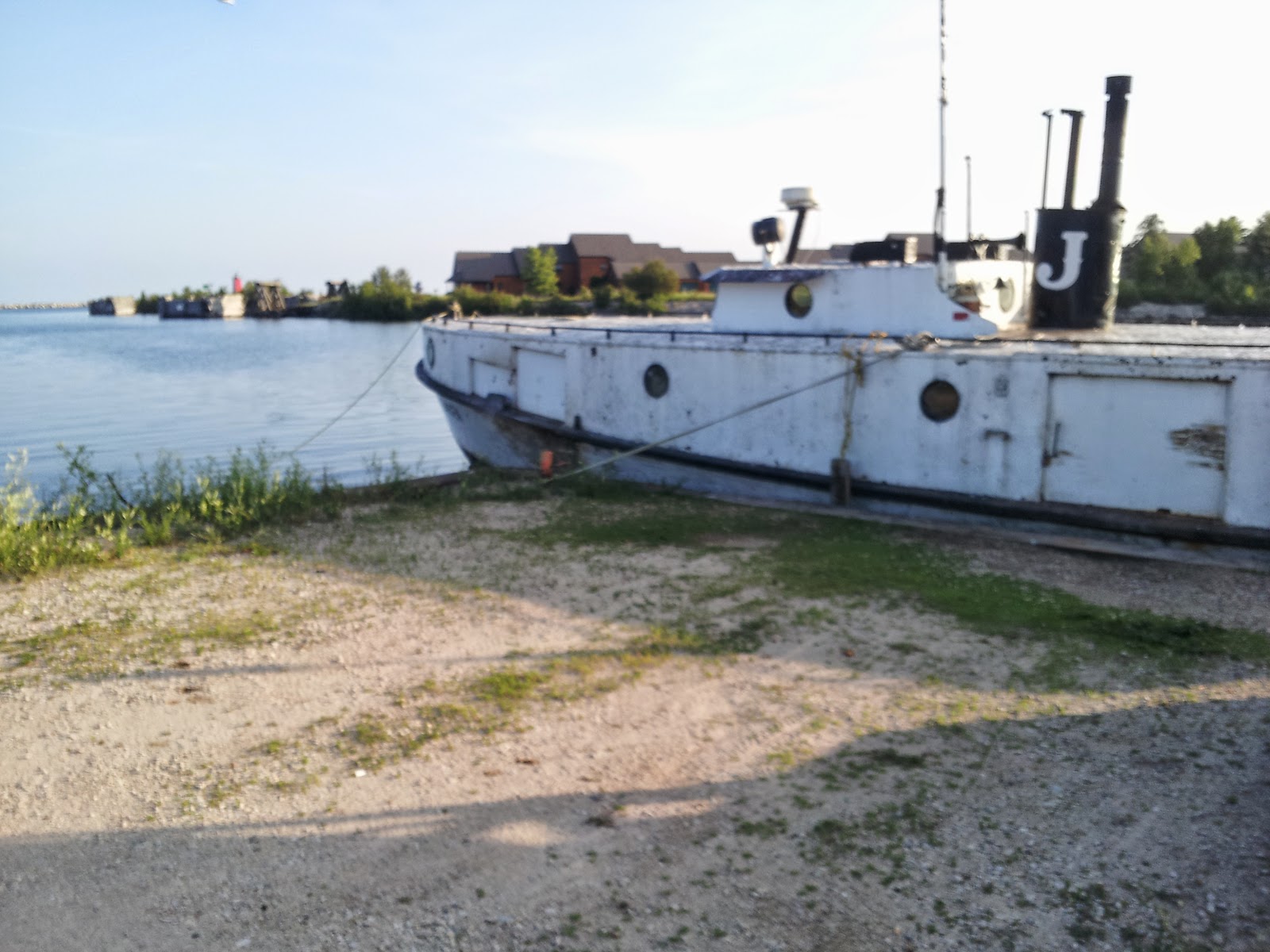
Back on shore, along the river in the shelter of the breakwater, there is this lovely old boat.


And along the path on the way back to the hotel, a half-hidden flower:


Friday, August 01, 2014

Blame Canada!

It's the first day of the big trip!  We spent the morning packing and preparing, left Newton Avenue before noon, stopped briefly at the lake and turned West with high hearts ready for adventure.  Gorgeous hot summer day, perfect for  a road trip.  We saw drumlins and a fawn and possibly a bald eagle in the Montezuma Refuge, and the sky got bigger and higher and wider the way it does as you drive west across New York.  The route plan was to head for Niagara Falls, cut across Ontario to Port Huron, Michigan, and then turn north up the Mitten and then west again across the Upper Peninsula between Lakes Michigan and Superior toward Minnesota, North Dakota and Montana. Good plan, huh?  Except we forgot to bargain for the 21st century headache of crossing the border between the US and Canada.

It dawned on us when we got near Buffalo around 3:30 and started seeing signs with startling crossing wait times that the border might be a problem.  Of the several crossings (Peace Bridge, Rainbow Bridge, and the one in Lewiston at I190)  Rainbow Bridge -- the one right by the falls -- looked best.  So, we drove blithely over Grand Island and into Niagara Falls -- and, on Niagara Avenue, hit traffic.  Serious traffic.  Sit still and don't move for minutes at a time, and then move forward three feet and stop and sit still for some more minutes again traffic.  Worse yet, while you're sitting still, watch people at an intersection ahead of you pulling in front of you from another street, car after car after car after car, taking up all the spaces so that even when the light changes you still. can't. move.  We had no idea.  We shoulda gone to Toledo and turned North there.  Too late now!


I did not take that picture; I stole it from the results of a Google search for "Niagara Falls traffic congestion."  However, that's pretty much how it looked, except you have to imagine the RV pulling a "toad" -- a small car on a trailer -- in the lane on our right, that couldn't wait for a space in the traffic and pulled out so that it entirely blocked an intersection, cutting off a line of cars trying to get through the line of cars trying to get into Canada (never move to Niagara Falls) until a city bus showed up and nosed its way belligerently right up to the toad, couldn't cross, and WAITED, emanating diesel bus threat vibes.  Oddly, not many people honked.  Gridlock!

Two hours and fifteen minutes of stop-and-start, mostly stop driving later, we reached a nice bored Canadian man in a booth who took less than a minute and a half to glance at our passports, ask a couple of questions and wave us through.  We did get glimpses of the American and Canadian falls and the gorge from the bridge, at least.


But mostly, it looked like this:


Well.  After that it was smooth sailing.  We took the Queen Elizabeth Way through St. Catherine's to Hamilton.   There's a whole lot of healthy-looking new industry and retail in Ontario, and also plenty of new housing construction.  Things are buzzing.  Clean, busy, growing ,thriving.   Except, they don't mow the grass along the highway, which makes it look as if the apocalypse just happened and everyone's escaping.  

Eventually we reached London, where we are now holed up in a Howard Johnson's.  (First we had trouble paying for gas with our U.S. credit card, then we drove around sleepily hunting without success for a motel, then we found the Casa Blanca, where the nice guy who ran the place didn't have the room we needed but picked up the phone and called up his son at the Howard Johnson's up the road and fixed us up.  People in Canada are notably nice.)  In the morning, we'll brave the crossing back into the US at Sarnia.  Wait times there were 80 minutes earlier this evening, according to my phone, but we're hoping mornings might be better.  After that -- Michigan!  

Update:  Dad says Canada is like a foreign country.